
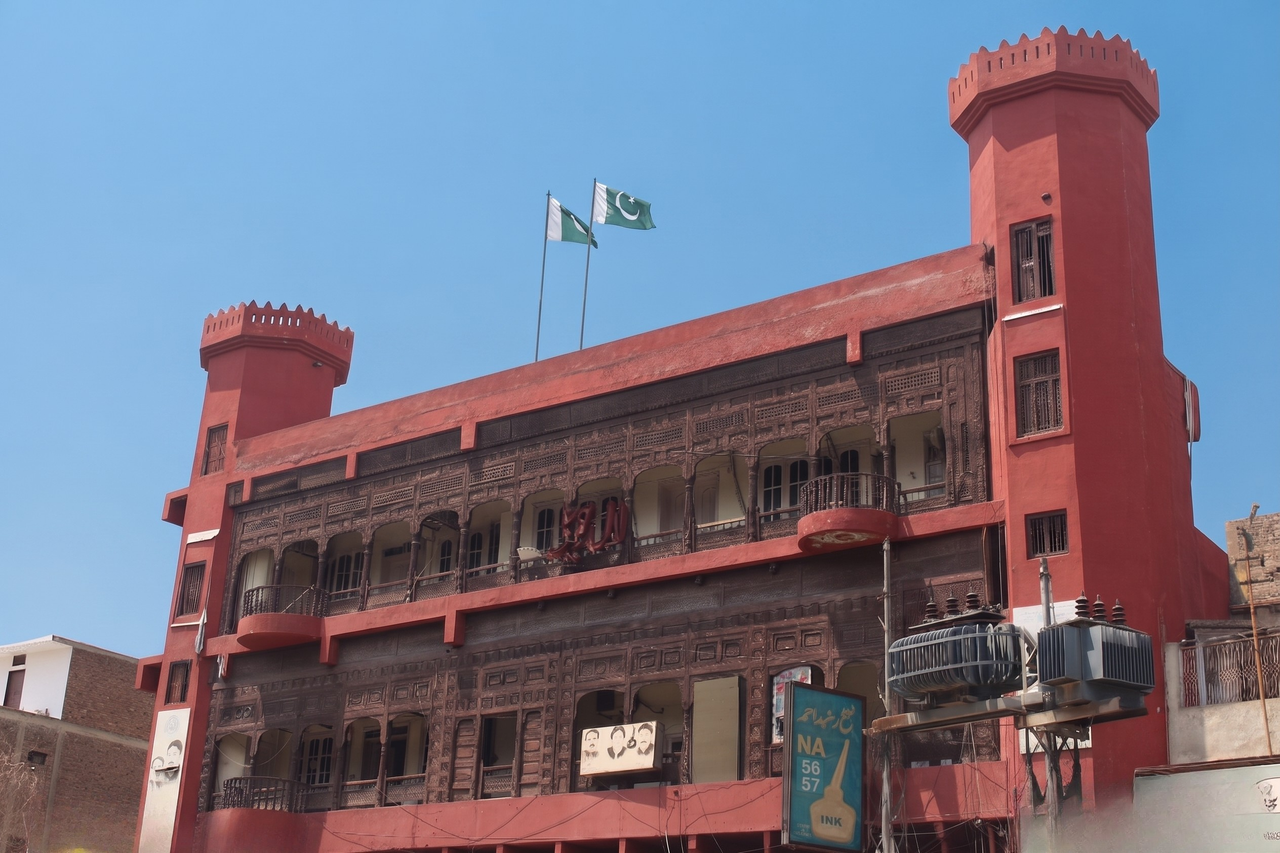
Not every heritage building earns its fame through royal visits or merchant fortunes alone some become landmarks because of the human stories embedded in their walls. Lal Haveli, nestled in Rawalpindi's Bohar Bazaar, is exactly that kind of place: a building born out of love, faith, and devotion, which later became one of the city's most recognizable political addresses. Its story spans dancing girls, interfaith devotion, Partition-era upheaval, and modern political power struggles making it one of the richest, most human narratives among Rawalpindi's historic buildings.
A Haveli Built for Love
Lal Haveli's origin story is unlike that of any other landmark in Rawalpindi's old city. The building was constructed by Dhan Raj Sehgal for Budhan Bai, a well-known dancing girl from Sialkot with whom he shared a relationship. Far from being a passing fling memorialized in brick and mortar, this was a serious, long-term connection one significant enough that Sehgal chose to build an entire haveli in her honor.
Budhan Bai herself was no minor figure in Rawalpindi society. She was reportedly one of the richest women in the city during her time, a remarkable achievement given the social constraints placed on women and particularly on dancing girls and courtesans in that era. Perhaps the most telling detail of her wealth and status: she owned the only automobile in Rawalpindi at the time, a distinction that would have made her instantly recognizable and set her apart from virtually everyone else in the city, regardless of gender or profession.
Two Faiths, One Compound
One of the most remarkable aspects of Lal Haveli's history is how it handled the religious differences between its two central figures. Rather than either party converting to the other's faith a common expectation in relationships that crossed religious lines during that period Dhan Raj Sehgal took a different approach entirely. He built a temple for himself and a mosque for Budhan Bai, both located within the same compound.
"Instead of erasing either person's religious identity, the architecture of Lal Haveli physically preserved both, side by side, under one roof."
This decision reflects a level of mutual respect and religious tolerance that feels striking even by today's standards, let alone within the social context of early twentieth-century Punjab. Instead of erasing either person's religious identity, the architecture of Lal Haveli physically preserved both, side by side, under one roof. It's a detail that transforms the building from simply an attractive piece of architecture into a genuine artifact of interfaith coexistence.
Architectural Character
Lal Haveli reflects the traditional haveli architectural style common to Punjab's old cities, built around functionality and privacy as much as visual grandeur. Carved wooden balconies and verandas overlook the bustling bazaar below, allowing residents to observe street life while maintaining a degree of separation from it a classic feature of South Asian haveli design.
Inside, the building includes separate private chambers, multiple courtyards, and a main hall, all arranged to balance private family life with the space needed for hosting guests and conducting business. This layout would have suited the haveli's dual role as both a residence and, given Budhan Bai's prominence, likely a social hub for Rawalpindi's elite.
Partition and Personal Loss
The upheaval of Partition in 1947 reshaped Lal Haveli's story just as it did countless other properties across Punjab. The original owners left for India as the subcontinent was divided, a fate shared by millions of families uprooted from their homes almost overnight. Budhan Bai, however, initially chose to remain in Rawalpindi — a decision that speaks to how deeply rooted she had become in the city she called home.
Her stay didn't last, though. Following the murder of her brother, Budhan Bai eventually left the haveli and the city altogether. This tragic turn adds a somber layer to the building's history, transforming it from a monument of love and religious tolerance into a reminder of the violence and loss that so many families experienced during and after Partition.
With its original inhabitants gone, the property came under the control of the Evacuee Trust Property Board (ETPB), the government body responsible for managing properties left behind by those who migrated during Partition a bureaucratic fate shared by thousands of abandoned havelis, temples, and estates across Pakistan.
From Forgotten Haveli to Political Headquarters
Lal Haveli's modern chapter began in an unlikely way. In the 1980s, a young bookseller named Sheikh Rashid Ahmad worked near the haveli's entrance and became fascinated by the building. That fascination eventually turned into ownership, as Sheikh Rashid later acquired part of the property.
Sheikh Rashid Ahmad went on to become one of Pakistan's most prominent and outspoken politicians, and Lal Haveli became the political headquarters of his Awami Muslim League. In this way, a building once defined by a private love story and religious devotion transformed into a very public symbol of political power its name recognized by anyone following Pakistani politics, even those unaware of its origin story.
A Modern Legal Battle
Lal Haveli's story continues to evolve even in recent years. In January 2023, the Evacuee Trust Property Board sealed the property amid a dispute over illegal occupation, thrusting the historic site back into headlines and legal proceedings. The Lahore High Court later annulled the sealing order in October 2023, ordering a fresh hearing into the matter leaving the haveli's legal status, at least partially, still unresolved.
This ongoing dispute is a reminder that heritage buildings in Pakistan are rarely just historical curiosities; many remain entangled in active legal, political, and property battles that shape their future just as much as their past.
Why Lal Haveli Still Matters
Few buildings anywhere combine romance, religious tolerance, tragedy, and modern political history quite like Lal Haveli. It stands as physical proof of a relationship that defied social and religious boundaries, a testament to one woman's remarkable rise to wealth and independence, and a case study in how Partition reshaped ownership and memory across Punjab's old cities.
Today, walking through Bohar Bazaar, most passersby know Lal Haveli primarily as a political landmark tied to Sheikh Rashid Ahmad. But underneath that modern identity lies a much older and more personal story one of Dhan Raj Sehgal and Budhan Bai, and the extraordinary haveli they built together, faith by faith, courtyard by courtyard, in the heart of old Rawalpindi.