
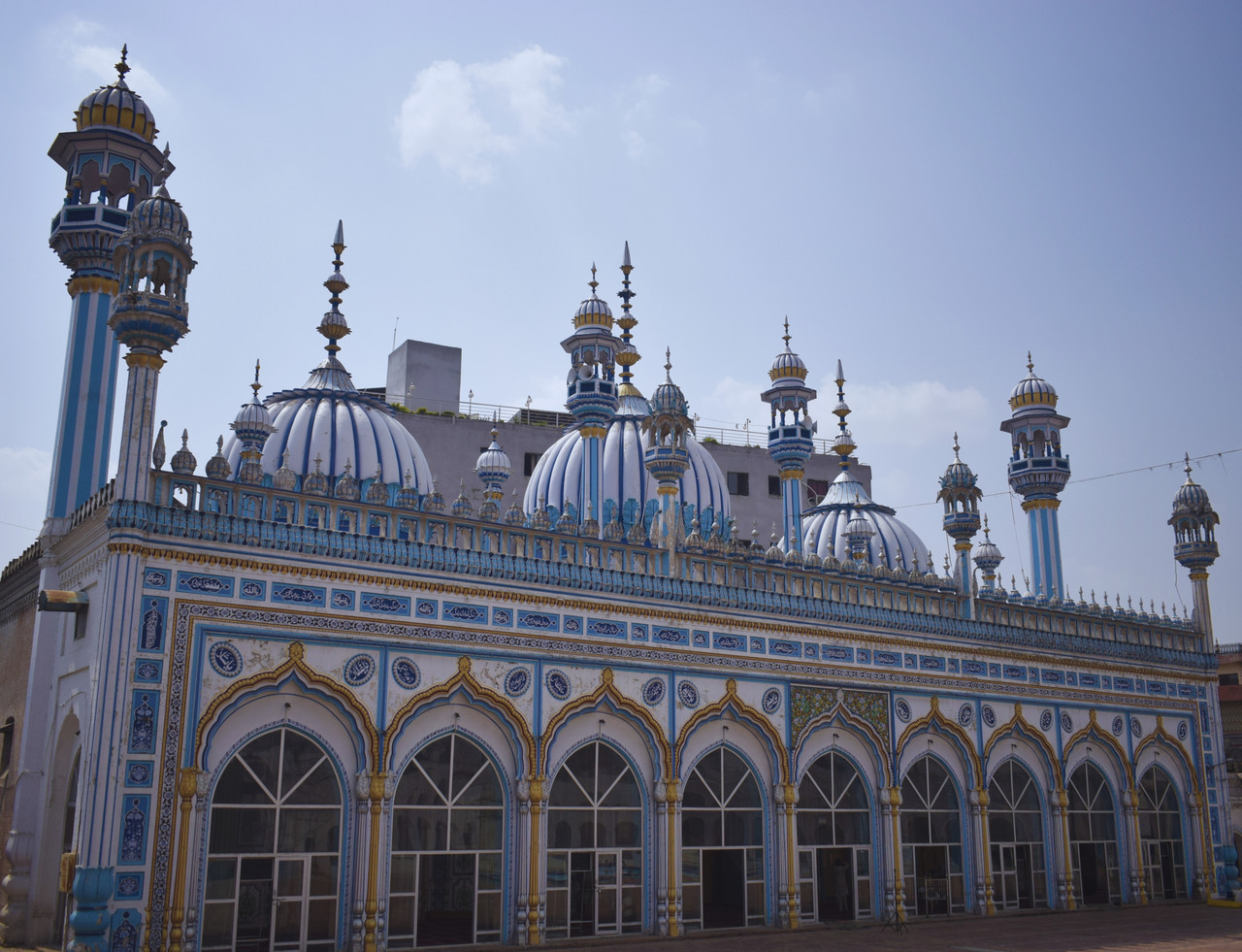
At the heart of Rawalpindi's old city stands a mosque so significant that an entire road was named in its honor. The Central Jamia Masjid, located on Jamia Masjid Road, isn't just a place of worship it's a masterclass in Mughal-inspired craftsmanship and one of the last strong examples of this architectural tradition surviving in the Potohar region. More than a century after its construction, its tilework and frescoes remain remarkably vivid, offering visitors a rare, direct connection to a fading architectural legacy.
A Mosque That Named a Street
Built in 1902, the Central Jamia Masjid has become so central to its surrounding neighborhood that the road itself Jamia Masjid Road was named after it. This naming convention speaks volumes about the mosque's importance within the local community from the moment it was completed. Rather than simply occupying a street, the mosque effectively defined it, becoming the anchor point around which the surrounding old-city neighborhood organized itself.
More than 120 years later, that relationship between mosque and street remains intact, with Jamia Masjid Road continuing to serve as one of the key arteries through Rawalpindi's historic core.
Entering Through a Single Gate
Unlike some grand mosques with multiple grand entrances, the Central Jamia Masjid channels visitors through a single gate on the eastern side of the building. This design choice creates a more intimate, focused entry experience, guiding worshippers and visitors alike into the mosque's open courtyard through one deliberate point of access.
Once inside, the courtyard opens up to reveal the mosque's most visually striking architectural elements: three prominent domes and accompanying minarets that dominate the skyline above the courtyard. These domes serve as both a functional and symbolic centerpiece, marking the building's silhouette from a distance while framing the courtyard's open space below.
Kashi-Kari: The Mosque's Defining Feature
If there's one element that sets the Central Jamia Masjid apart from other historic mosques in the region, it's the exceptional kashi-kari, or glazed tile work, that covers its walls and archways. This decorative technique, deeply rooted in Persian and Mughal artistic traditions, involves intricate ceramic tiles arranged into elaborate geometric and floral patterns.
"The patterns reflect classic Mughal design sensibilities repeating geometric forms interwoven with stylized floral motifs, a visual language instantly recognizable to those familiar with the broader Mughal architectural tradition."
The patterns found throughout the mosque reflect classic Mughal design sensibilities repeating geometric forms interwoven with stylized floral motifs, a visual language that would have been instantly recognizable to worshippers and visitors familiar with the broader Mughal architectural tradition that flourished across the subcontinent.
Frescoes That Have Defied Time
Alongside the glazed tilework, the mosque features elaborate frescoes that add another dimension of color and detail to its interior and exterior surfaces. These frescoes showcase a vivid palette red, blue, green, and gold arranged into floral motifs and calligraphic inscriptions that wrap across the domes and walls of the building.
What makes these frescoes particularly remarkable is their state of preservation. Despite being over a century old, the colors have retained their vibrancy, a testament both to the quality of the original craftsmanship and pigments used, and to whatever care and maintenance the mosque has received over the decades. In a region where many historic frescoes have faded, cracked, or been painted over entirely, the Central Jamia Masjid's preserved artwork stands out as an increasingly rare survival.
A Rare Survivor of Mughal Architecture in Potohar
Perhaps the most significant claim to fame for the Central Jamia Masjid is its status as one of the few remaining strong examples of Mughal-style architecture in the Potohar region. The Potohar Plateau, which encompasses Rawalpindi and its surrounding areas, has a rich architectural history, but much of it has been lost to development, neglect, or the simple passage of time.
Against that backdrop, the Central Jamia Masjid's survival complete with intact kashi-kari tilework and vibrant frescoes makes it an increasingly important reference point for understanding what Mughal-influenced religious architecture looked like in this specific region, as distinct from the more famous Mughal monuments found in Lahore, Agra, or Delhi.
Why the Mosque's Craftsmanship Matters
The Central Jamia Masjid's significance goes beyond its role as an active place of worship, though that function remains central to its identity. As a piece of architectural heritage, it represents a specific regional interpretation of Mughal design principles one shaped by local materials, local artisans, and the particular aesthetic sensibilities of early twentieth-century Rawalpindi.
The combination of glazed tilework and painted frescoes reflects a level of artistic investment that went well beyond basic religious functionality. Whoever commissioned and built this mosque in 1902 clearly intended it to stand as a visual and spiritual landmark, not merely a functional gathering space and more than a century later, that ambition still shows in every archway and dome.
Visiting the Central Jamia Masjid
For visitors exploring Rawalpindi's old city, the Central Jamia Masjid offers a rare opportunity to see well-preserved Mughal-style religious architecture up close, without needing to travel to Lahore or beyond. The single eastern gate, the open courtyard framed by three domes and minarets, and the vividly colored kashi-kari and frescoes combine to create one of the most visually rich heritage sites in the city.
As with any active place of worship, visitors should approach with appropriate respect and awareness of prayer times and customs. But for anyone interested in Islamic architecture, Mughal design traditions, or simply the layered history of Rawalpindi's old city, the Central Jamia Masjid remains an essential and still relatively under-recognized stop. More than a century after its construction, it continues to serve both as a functioning mosque and as a living museum of Mughal-era craftsmanship, right in the heart of the Potohar region.